Blogs

What is KVM?
May 30, 2025
Snowflake to Acquire Crunchy Data For $250 Million to Enhance PostgreSQL Services
June 3, 2025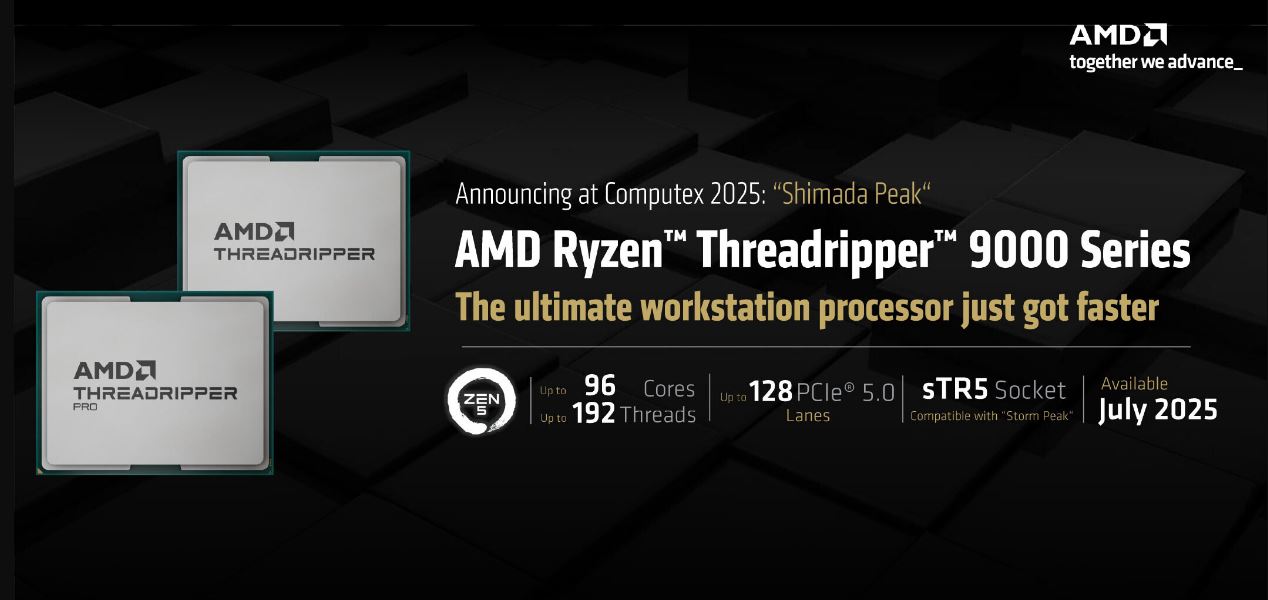
AMD Launches Threadripper CPUs at Computex 2025. This is a major move into the high-performance workstation and high-end desktop (HEDT) markets with the launch of its latest Ryzen Threadripper Pro 9000 WX-Series and Ryzen Threadripper 9000 Series processors. These new chips are specifically designed to tackle demanding workloads such as VFX rendering, CAD design, scientific simulations, and AI development tasks often handled in enterprise-grade workstations used in engineering, healthcare, defense, and data science industries.
Table of Contents
AMD Launches Threadripper CPUs: Key Details
With this launch, AMD is positioning itself as a serious challenger to Intel’s Xeon series, which has long been dominant in professional workstation environments. The new processors offer a combination of high core counts, massive cache, and wide platform support, directly aimed at professionals and enterprises that need robust, scalable computing power.
During its keynote at Computex, AMD demonstrated the capabilities of its new flagship processor, the Ryzen Threadripper Pro 9995WX, using Cinebench. According to AMD, the 9995WX outperforms both its predecessor, the Threadripper Pro 7995WX, and Intel’s current high-end Xeon W9-3595X, boasting up to 2.2x faster rendering performance.
The Ryzen Threadripper Pro 9995WX features 96 cores and 192 threads, targeting CPU-intensive tasks such as visual effects production, engineering simulations, and artificial intelligence model training. It includes up to 384MB of L3 cache and supports 128 PCIe 5.0 lanes, enabling substantial connectivity and bandwidth. This is crucial for professionals working with large datasets, multiple GPUs, and high-bandwidth memory applications.
Manish Rawat, a semiconductor analyst at TechInsights, highlighted that AMD’s new Threadripper Pro lineup is designed not just for performance, but also for enterprise needs, with AMD PRO Technologies providing enhanced security, manageability, and platform stability. These features aim to simplify IT deployment and operations, which are key concerns for businesses managing large-scale computing infrastructures.
According to Rawat, the standout feature of the 9000 WX-Series is the sheer density of its cores and threads. AMD’s 96-core flagship clearly surpasses Intel’s Xeon W-3400 series, which tops out at 56 cores. This enables AMD to handle more simultaneous tasks and threads, essential for heavy-duty professional workloads. Combined with its expansive cache and memory bandwidth, the Threadripper Pro 9995WX offers significant performance advantages for industries dependent on rapid data processing and high parallel compute tasks.
While Nvidia currently holds a commanding lead in GPU-centric AI workloads, AMD’s strategy with the Threadripper Pro 9000 Series is to complement powerful GPUs, including Nvidia’s, in hybrid CPU-GPU workflows. These combinations are increasingly crucial in AI development, where rapid data processing and real-time inference often require both CPU and GPU strength. AMD is also pushing its ROCm ecosystem and the Radeon AI PRO R9700 to enable smoother CPU-GPU integration for AI, machine learning, and creative software, aiming to become a full-stack platform provider in the professional computing space.
In addition to the Pro series, AMD also launched the Ryzen Threadripper 9000 Series, which is designed for HEDT users such as content creators, software developers, and local AI model trainers. These processors deliver up to 64 cores and are optimized for users who require workstation-class power in a desktop environment. AMD is targeting professionals who want to reduce reliance on cloud services for tasks like compiling code, editing high-resolution video, and training small to medium AI models. By offering local computing power, users can cut down on cloud costs, reduce latency, and maintain greater data privacy.
The demand for high-end local compute capabilities has grown in recent years as enterprises and creators increasingly need powerful hardware that can support real-time processing and content creation without internet dependency. AMD’s Threadripper 9000 Series addresses this gap by bringing enterprise-grade performance into desktop systems.
Meanwhile, Intel has been repositioning its HEDT lineup to blur the lines with workstation-class CPUs, promoting its Xeon W-Series as ideal solutions for workloads like 3D rendering, CAD, and AI prototyping. This intensifies competition in the space, pushing AMD to differentiate further by expanding its ecosystem and enhancing software support.
Rawat noted that to effectively challenge Intel and Nvidia in enterprise environments, AMD must grow its ecosystem through deeper collaboration with independent software vendors (ISVs) and system integrators. Offering more pre-configured systems tailored to specific workloads, along with certified software support, could help AMD build trust among enterprise buyers. Certifications, long-term support plans, and robust deployment tools features, where Intel has historically led with its vPro platform, are crucial for AMD to secure a long-term foothold in the enterprise market.

Featured Post

Snowflake and OpenAI Seal $200M Strategic Alliance to Transform AI For Enterprise Data Platforms
Snowflake, the AI Data Cloud leader, and OpenAI this week announced a multi-year, $200 million strategic partnership that will bring advanced artificial intelligence models directly into […]

saad ullah
March 4, 2026

Cisco Live EMEA 2026: Powering the AI Era with Smarter Networks, Security, Collaboration and Agentic Intelligence
At Cisco Live EMEA 2026 in Amsterdam, Cisco unveiled a sweeping portfolio of innovations designed to transform enterprise infrastructure, secure AI-driven environments, and redefine workplace collaboration […]

Sarmad Hasan
February 25, 2026
Microsoft Unveils Maia 200 AI Chip to Take On AWS, Google and Nvidia in Cloud AI Race
Microsoft Unveils Maia 200 AI Chip to Take On AWS, Google and Nvidia in Cloud AI Race. Microsoft has officially launched its next-generation AI accelerator chip, […]
Sarmad Hasan
February 23, 2026