Blogs

Dedicated Server for FinTech: The Ultimate Guide
July 18, 2025
Microsoft Warns Governments and Businesses of Active “Zero‑Day” Attacks Targeting SharePoint Servers
July 22, 2025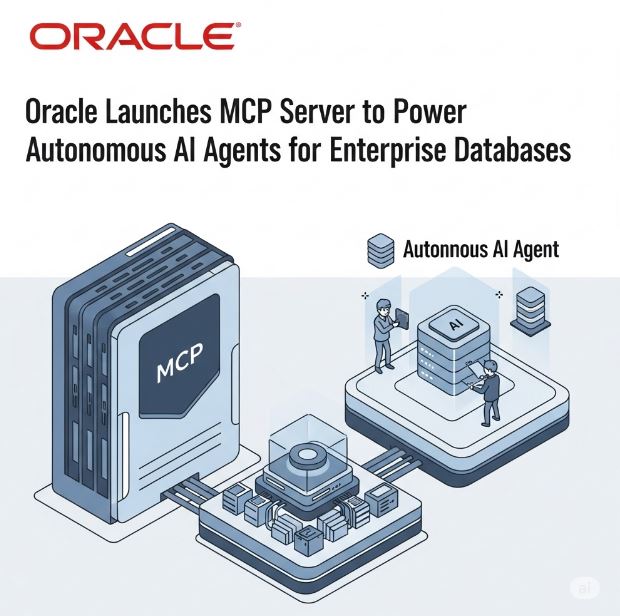
Oracle launches MCP server to power autonomous AI agents for enterprise databases. It is a groundbreaking development aimed at enabling enterprises to build intelligent, agentic applications that can autonomously query, retrieve, and reason over data stored in Oracle Databases. Oracle launches MCP server to produce more context-aware responses from AI systems by allowing seamless, secure interaction with enterprise data using natural language prompts.
Oracle Launches MCP Server To Seamlessly Integrate With Its Developer Tools
The MCP server has been integrated into Oracle’s key developer tools, including Oracle SQLcl — the command-line interface (CLI) for Oracle Database. SQLcl, which is also part of Oracle SQL Developer and its Visual Studio Code (VS Code) extension, can now function as an MCP server. This integration enables AI assistants and agents to connect securely to Oracle Databases, run SQL and PL/SQL queries, and manage credentials directly on the end user’s machine.
Oracle stated in a recent blog post, “Oracle SQLcl can now be run as an MCP Server and provides MCP tools that allow an AI assistant to securely connect to Oracle Database.” This makes the Oracle Database instantly accessible to any platform that supports the MCP framework, dramatically simplifying the process for developers.
Boosting Productivity and Reducing Complexity
Oracle launches MCP server to reduce the need for custom integration layers, which have traditionally been necessary for enterprise applications to interact with Oracle Databases. This move simplifies workflow automation services and enhances productivity by automating repetitive SQL tasks through agentic AI automation.
According to Raya Mukherjee, senior analyst at Everest Group, “The SQLcl tool inside the MCP server will allow external agents to query metadata, access schema details, generate and execute SQL, and interact with Oracle databases in a structured and standardized way.” This not only reduces development complexity but also accelerates the deployment of AI-powered applications across various enterprise sectors.
Mukherjee emphasized the value this brings to sectors such as banking, financial services, and insurance (BFSI), where agents could automate fraud detection, audit trail retrieval, and compliance reporting using existing data in Oracle Databases. Similarly, in retail, agentic AI could provide real-time inventory insights, analyze sales trends, and forecast demand, streamlining operational decision-making.
Enabling AI-Driven Business Insights
Oracle launches MCP servers to enable AI agents to directly query Oracle databases and deliver real-time answers to operational questions. This can augment existing dashboards and business intelligence tools by enabling users to obtain insights from data that may not be covered in static reports.
By leveraging natural language queries, business users can tap into the power of large language models (LLMs) to retrieve specific information, conduct analyses, and generate summaries — all without requiring manual SQL input or deep technical expertise.
Charlie Dai, VP and principal analyst at Forrester, noted that this development addresses a critical hurdle in AI adoption in Oracle-dominant sectors like pharma, healthcare, and retail. “The new MCP server from Oracle will accelerate enterprise AI integration by allowing enterprises to automate Oracle Database interactions based on natural language queries that activate agents and their supporting LLMs,” he said.
Strengthening Security for Autonomous Agents
While the potential for agentic AI in enterprise environments is significant, Oracle has cautioned organizations about associated security risks — particularly the possibility of unauthorized access to sensitive data by LLMs or automated agents.
To mitigate these risks, Oracle is urging database administrators to enforce strict access controls by ensuring that the database users leveraged by MCP servers are assigned only the minimum necessary privileges. “This will limit what is accessible to the LLM,” Oracle noted in its guidance.
Additionally, the company recommends routing agent access to sanitized, read-only replicas or curated subsets of production databases. This approach reduces the risk of data breaches while still enabling rich query capabilities.
Regular audits of LLM-executed queries are also advised to detect anomalies or unauthorized access attempts. This monitoring can act as a safeguard against misuse or data leakage when deploying AI agents at scale.
Developer Accessibility Through VS Code
To further support developer adoption, Oracle is offering easy access to the MCP server through its SQL Developer Extension for Visual Studio Code. Upon activation, the extension automatically registers the MCP server, making it readily available for use with Microsoft Copilot and other LLM-based assistants within the VS Code environment.
This streamlines the developer experience, allowing enterprises to begin experimenting with and deploying AI-driven database agents without significant retooling.
Conclusion
Oracle launches MCP server to revolutionize enterprise AI integration. By allowing autonomous agents to query and interact with Oracle Databases in a secure, standardized, and natural language-driven manner, it empowers both developers and business users to unlock new productivity gains and insights. With built-in support in SQLcl and seamless integration into Visual Studio Code, Oracle is making it easier than ever for enterprises to bring agentic AI into everyday operations — all while maintaining robust data security protocols.

Featured Post
OpenAI Partners With Cerebras and Sign $10 Billion Compute Deal
OpenAI partners with Cerebras Systems, securing massive capacity designed to accelerate the performance of its AI models, including ChatGPT. Interested in learning more about the deal? […]

Sarmad Hasan
January 28, 2026

Google to Acquire Intersect Power For $4.75 Billion
Google to acquire Intersect Power in the first half of 2026, accelerates Google’s efforts to meet soaring demand for computing power driven by generative AI, Google Cloud, […]

saad ullah
January 26, 2026
Microsoft Acquires Osmos to Supercharge AI-Driven Data Engineering in Fabric
Microsoft acquires Osmos to supercharge AI-driven data engineering in Fabric. This makes it a strategic move to accelerate and simplify data workflows within its Microsoft Fabric […]
saad ullah
January 21, 2026