Blogs

Black Hat 2025: 10 Cool New Cybersecurity Products Announced At The Conference
August 8, 2025
5 Cloud Encryption Tips for Businesses ( Infographic )
August 12, 2025
on
10 Server Provisioning Best Practices That Improve Security
Server provisioning is a foundational step in building and managing IT infrastructure. It involves preparing and configuring servers to meet specific performance, security, and application requirements. From physical machines to cloud-based instances, provisioning ensures that servers are ready to handle workloads efficiently. This article explores the different types of server provisioning, the tools used, and the best practices to follow for a smooth and scalable deployment process.
In this guide, HOSTNOC will share everything you need to know about server provisioning.
Server provisioning is a foundational step in building and managing IT infrastructure. It involves preparing and configuring servers to meet specific performance, security, and application requirements. From physical machines to cloud-based instances, provisioning ensures that servers are ready to handle workloads efficiently. This article explores the different types of server provisioning, the tools used, and the best practices to follow for a smooth and scalable deployment process.
In this guide, HOSTNOC will share everything you need to know about server provisioning.
Table of Contents
- What Is Server Provisioning?
- Server Provisioning Based on Context
- Why Is Server Provisioning Important?
- Types of Server Provisioning
- Server Provisioning Lifecycle
- Server Provisioning Tools and Techniques
- Server Provisioning Best Practices
- Server Provisioning Pitfalls
- How To Avoid These Server Provisioning Pitfalls?
- Future of Server Provisioning
- Conclusion
What Is Server Provisioning?
Server provisioning is the structured process of preparing and deploying a server, whether physical (bare-metal) or virtual, by installing the operating system, configuring network and storage resources, setting up security controls, and enabling it for operational use. It often includes selecting a server from a pool, applying a boot image, assigning IPs, and onboarding middleware and applications.
Server Provisioning Based on Context
Depending on context, server provisioning might mean:
- Automated provisioning vs. manual provisioning
- Bare‑metal provisioning vs. virtual/cloud provisioning
- Zero‑touch provisioning (ZTP) for large-scale deployments
Let’s look at each one in more detail.
Automated Provisioning vs. Manual Provisioning
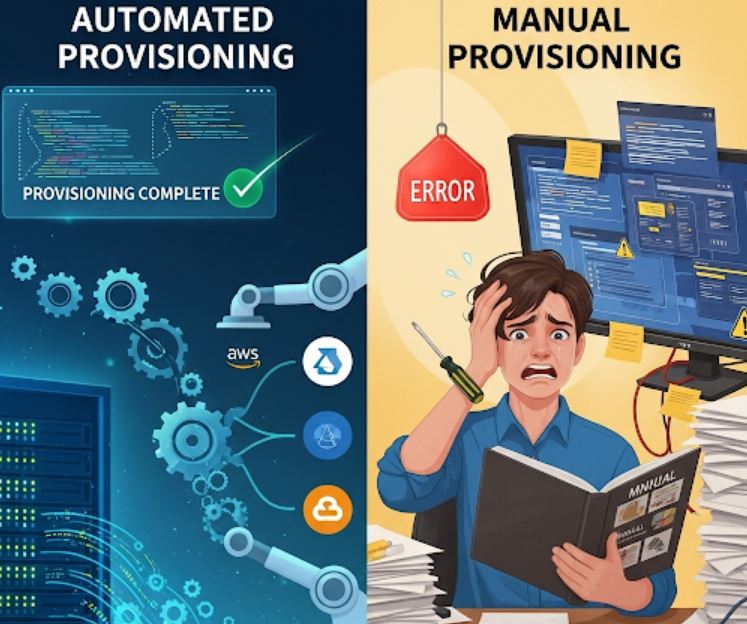
Automated provisioning uses scripts or software to configure systems without human intervention, increasing speed and consistency. Manual provisioning requires human input to install and configure systems, making it slower and prone to errors. Automation is ideal for scalability, while manual may be used for custom, one-off setups.
Bare-Metal Provisioning vs. Virtual/Cloud Provisioning
Bare-metal provisioning installs operating systems and server software directly on physical servers, offering high performance and full hardware control. Virtual/cloud provisioning deploys systems on virtual machines or cloud instances, allowing flexibility and fast scaling. Bare-metal is preferred for performance-sensitive tasks; virtual/cloud suits dynamic, scalable environments.
Zero-Touch Provisioning (ZTP) for Large-Scale Deployments
ZTP enables new devices to automatically configure themselves by connecting to a network and downloading settings. It’s commonly used in large-scale IT or network setups to minimize manual intervention and reduce deployment time. ZTP improves consistency and efficiency, especially in environments with hundreds or thousands of devices.
Why Is Server Provisioning Important?
Here are some of the reasons why server provisioning is important.
- Operational efficiency
Automating server setup accelerates deployment and removes repetitive manual tasks. - Consistency & standardization
Ensures identical server environments across data centers and clouds - Security by design
Embeds secure configuration from firewalls to RBAC right from provisioning - Scalability & agility
Spinning up/down server fleets becomes fast, fluid, and responsive to workload spikes - Compliance & auditability
Enables traceable provisioning, version control, and patch management - Cost optimization
Right-sizing resources, especially in the cloud, helps avoid over-provisioning and reduces costs
Types of Server Provisioning
-
Bare‑metal provisioning:
Bare-metal provisioning involves deploying an operating system and necessary software directly onto physical hardware nodes without any virtualization layer. This method is typically used for high-performance or specialized environments where direct hardware access is critical. It requires careful planning and manual or automated setup processes.
-
Virtual provisioning:
Virtual provisioning allows the creation of virtual machines using hypervisors or cloud APIs, abstracting hardware into software-defined instances. It offers flexibility, efficient resource utilization, and easier scalability. Virtual machines can be configured, deployed, and managed rapidly.
-
Cloud provisioning:
Cloud provisioning enables the dynamic allocation of compute, storage, and networking resources through cloud providers like AWS, Azure, or GCP. It supports elasticity, scalability, and pay-as-you-go models. Resources can be provisioned through dashboards, APIs, or automation tools.
-
Zero‑touch provisioning:
Zero-touch provisioning automates the entire boot and installation process without manual intervention, using technologies like PXE boot and DHCP. It’s ideal for deploying large numbers of systems consistently at scale. This method speeds up deployment and reduces human error.
-
Infrastructure as code (IaC):
Infrastructure as Code (IaC) is the practice of managing infrastructure using code, either declarative (e.g., Terraform) or imperative (e.g., Ansible) stored in version control systems. It ensures repeatability, versioning, and collaboration across teams. Infrastructure as code enables automated, consistent provisioning and configuration of infrastructure resources.
Server Provisioning Lifecycle
Here are some of the stages involved in the server provisioning lifecycle.
- Planning & image preparation (Day –200 to Day 0)
Define server roles, resource needs, golden images, and classification schemas - Image/build agent provisioning (Day 0)
Boot bootstrap images, install agents for config management (e.g., Puppet, Chef, Ansible) - Configuration management (Day 1 onward)
Apply system state via IaC tools, ensure idempotent, compliant configurations - Ongoing management
Include patching, server monitoring, auditing, and scaling. - Decommissioning
Safe shutdown, data sanitization, rollback, and resource cleanup.
Server Provisioning Tools and Techniques
Here are some server provisioning tools and techniques you can use to make the process seamless.
- PXE/DHCP boot + unattended installers (Kickstart, preseed) + Ansible/Chef/Puppet for full automation.
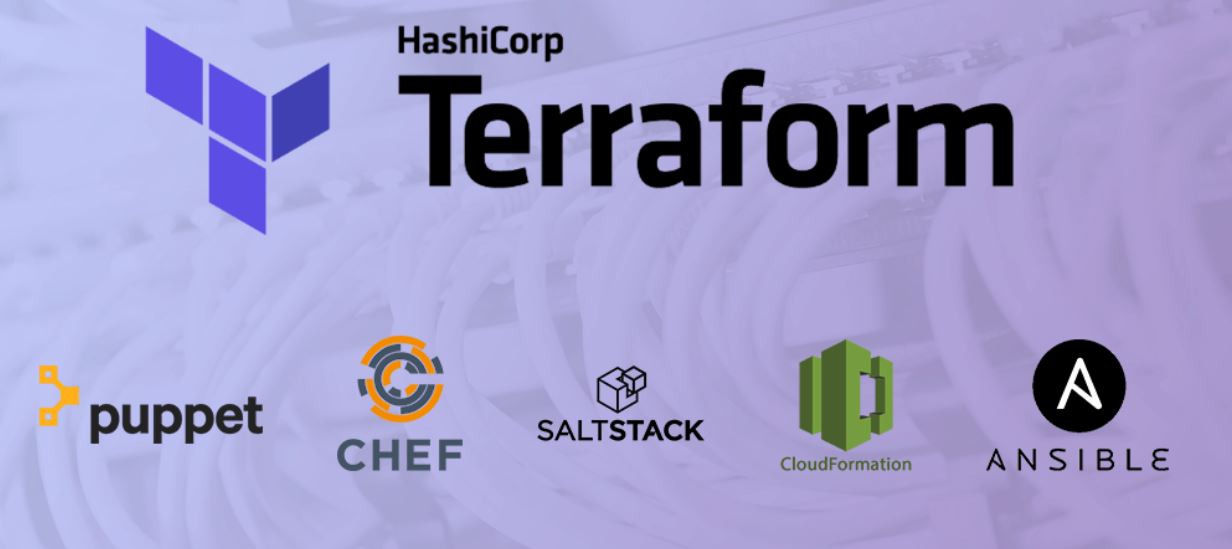
- IaC frameworks: Terraform, AWS CloudFormation, Ansible, Puppet, Chef
- Golden/silver/base images: Pre-baked templates for fast, consistent provisioning
- Zero‑touch provisioning (ZTP): Uses DHCP/TFTP and boot scripts to automate setups at scale
- Configuration management: Ensures ongoing compliance and drift prevention.
Server Provisioning Best Practices
Here are ten server provisioning best practices you can follow:
- Automate everything: Manual steps are error-prone and costly
- Use version control for IaC and provisioning scripts
- Create immutable golden images and update via CI/CD pipelines
- Classify nodes by role, OS, or environment for targeted provisioning
- Embed security from the start: implement firewalls, SSH hardening, patching, and RBAC.
- Audit & compliance checks: validate post-provision state matches policy
- Plan for lifecycle: include decommissioning, archiving, and resource reclamation.
- Standardize images/hardware to reduce variance
- Implement rollback & idempotence: safe failure recovery and repeatable state convergence.
- Integrate with DevOps & CI/CD: tie provisioning into pipelines with continuous delivery
Server Provisioning Pitfalls
Server provisioning, when not carefully managed, is prone to several common pitfalls that can lead to inefficiencies, security risks, and increased operational overhead.
Configuration Drift
One of the most frequent issues is configuration drift, where servers deviate from their intended state over time due to ad hoc changes or manual tweaks. This inconsistency can result in unpredictable behavior across environments.
Image Sprawl
Image sprawl, or the unchecked growth of VM or container images, can clutter infrastructure and complicate updates or audits.
Over-Provisioning
Over-provisioning is another common problem, where more resources than necessary are allocated, leading to wasted costs and poor resource utilization.
How To Avoid These Server Provisioning Pitfalls?
To avoid these pitfalls, teams should push everything into code and pipelines, leveraging Infrastructure as Code (IaC) to maintain consistency and version control. Tools like Ansible, Puppet, or Terraform help enforce configuration standards and prevent drift. A centralized golden-image registry ensures only vetted, secure, and up-to-date images are used, reducing sprawl. Regular monitoring and performance analytics can guide server optimization efforts and help right-size resources, avoiding the inefficiencies of over-provisioning.
Security and lifecycle management also require attention. Automating security hardening during the provisioning phase ensures that servers start compliant and secure. Embedding auditing and compliance checks directly into provisioning workflows helps detect and correct issues early. Lastly, to prevent orphaned resources, those no longer in use but still consuming resources, teams should implement automated cleanup processes triggered during decommissioning. By codifying these steps and enforcing them through CI/CD pipelines, organizations can significantly reduce risk and increase operational efficiency in server provisioning.
Future of Server Provisioning
- Serverless & container-first architectures reduce server provisioning as code.
- Edge provisioning & IoT require scalable ZTP-like strategies
- AI-driven provisioning tools: adaptive resource sizing based on real‑time metrics.
- Workflows shift to continuous, policy‑driven provisioning aligned with DevSecOps.
Conclusion
Server provisioning is more than just “installing an OS.” It’s a strategic, lifecycle-oriented, and automation-centric process that lays the foundation for scalable, secure, and efficient IT infrastructure. Embrace IaC, golden images, ZTP, and DevOps practices to future-proof your provisioning workflows. Did this guide help you in understanding everything you need to know about server provisioning? Share it with us in the comments section below.

Featured Post
Dedicated Server For Government: Everything You Need to Know
In an era where digital transformation defines national competitiveness, governments around the world are investing heavily in resilient, secure, and scalable infrastructure. Among all infrastructure choices, […]

Sarmad Hasan
March 11, 2026
Dedicated Server with SSD: High-Performance Hosting for Mission-Critical Workloads
A Dedicated Server with SSD (Solid State Drive) is a premium hosting solution in which an entire physical server is allocated to a single user and […]
Sarmad Hasan
March 6, 2026
Dedicated Server with Backup: Everything You Need To Know
A Dedicated Server with backup is a high-performance hosting solution that combines exclusive physical server resources with robust data protection mechanisms. Unlike shared hosting or virtual […]
Sarmad Hasan
March 2, 2026