Blogs
Salesforce Drift Data Breach Impacts Google, Cloudflare & More
September 8, 2025
How Does Server Location Impact Performance? ( Infographic )
September 10, 2025
on
7 Server Trends You Can Not Afford To Ignore In 2026
In 2025, organizations are increasingly rethinking their over-reliance on public cloud infrastructure, with a strong shift toward cloud repatriation and dedicated servers. A majority of enterprises are already moving workloads back on-premises or into private environments, citing cost, compliance and performance as key factors. This movement reflects a broader shift toward hybrid and on-prem strategies that offer greater control and predictability over IT infrastructure. The continued use of dedicated servers highlights that not all workloads benefit from a cloud-first approach.
At the same time, server trends are reshaping infrastructure at the edge and core. The rise of IoT, 5G and real-time applications is pushing more processing to the network edge, with modular and hyper-converged systems enabling easier scaling and management. Parallelly, AI-optimized infrastructure is gaining ground, as companies adopt AI-specific hardware and AI-driven management tools to improve performance and reduce operational costs. Innovations like PCIe Gen-5 SSDs are revolutionizing data storage by delivering massive capacity with better energy efficiency, setting new standards for storage-intensive environments.
Sustainability and security have become central to infrastructure design. Advanced cooling technologies like liquid and immersion cooling, along with energy-efficient hardware, are reducing environmental impact. The average Power Usage Effectiveness (PUE) has improved, while sustainable practices such as waste heat reuse are becoming standard.
Meanwhile, software-defined and composable infrastructures offer more dynamic and flexible deployment options, particularly valuable in hybrid and remote setups. As cybersecurity threats like ransomware rise, security features are now built into server hardware, reinforcing the growing adoption of hybrid and multi-cloud architectures that balance agility, security, and cost efficiency.
In this article, HOSTNOC will reveal seven server trends you can not afford to ignore in 2026.
Table of Contents
- 7 Server Trends You Can Not Afford To Ignore In 2026
- 1. Cloud Repatriation and Dedicated Servers Make a Comeback
- 2. Edge and Modular Computing Accelerates
- 3. AI‑Optimized and Accelerated Infrastructure
- 4. Storage Revolution: Massive Gen‑5 Solid State Drives
- 5. Cooling & Sustainability Innovations
- 6. Hyper‑Converged, Composable & Software‑Defined Infrastructure
- 7. Optimization, Security & Hybrid Architecture
7 Server Trends You Can Not Afford To Ignore In 2026
Here are seven server trends that you should keep an eye on in 2026
1. Cloud Repatriation and Dedicated Servers Make a Comeback
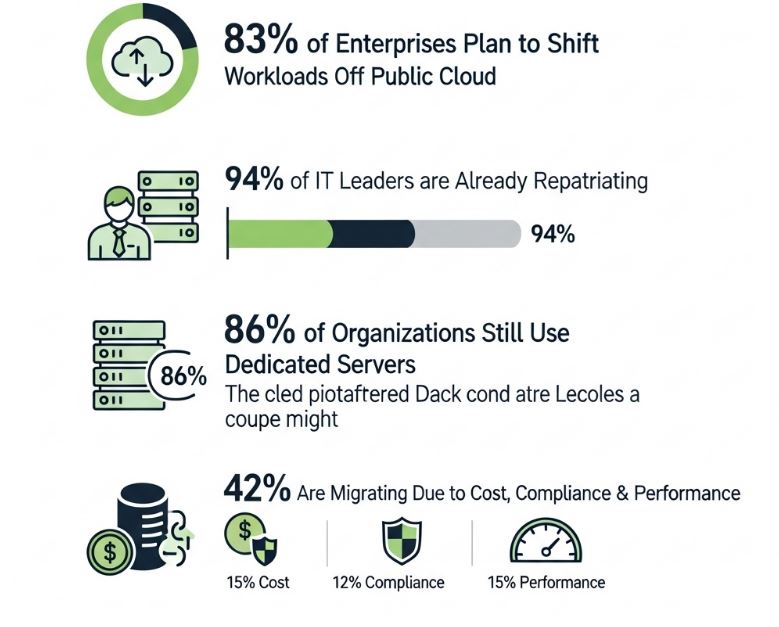
Many organizations are rethinking blanket reliance on the public cloud. Cloud repatriation, the return of workloads to private, on‑premises environments, is increasingly popular. A 2024 Barclays survey showed 83% of enterprises plan to shift workloads off public cloud, with 94% of IT leaders already repatriating. Similarly, a Liquid Web study found 86% of organizations still use dedicated servers with 42% migrating from public cloud in the past year due to cost, compliance and performance concerns.
Ryan MacDonald, Chief Technology Officer at Liquid Web, said: “IT professionals migrating workloads back from public cloud to dedicated environments underscores a deliberate strategy to reclaim control, customization and predictable costs.” This trend underscores that in 2026, a hybrid or on‑premise strategy is often the prudent choice, not just the cloud-first mantra.
2. Edge and Modular Computing Accelerates
The rise of Internet of Things, 5G and real‑time requirements continues to push computing resources toward the network edge. In fact, Gartner projected as much as 75% of enterprise data will be created and processed at the edge by 2025, a dramatic increase from 10% in 2018. Hyper-converged infrastructure (HCI) and modular server designs further support this momentum.
HCI simplifies management by combining compute, storage and networking, while modular systems enable flexible scaling and updating of individual components. Cisco’s Tim Stack noted modularity allows for shapeable resource allocation adapting to new technologies like accelerators and faster networking.
3. AI‑Optimized and Accelerated Infrastructure
AI workloads are reshaping server architecture. Dell’s $10 billion AI‑server business is projected to grow 50% in 2025 as organizations move from experimentation into full deployment. Nvidia has even booked entire production capacity through 2026 to meet demand for its Blackwell‑based AI servers.
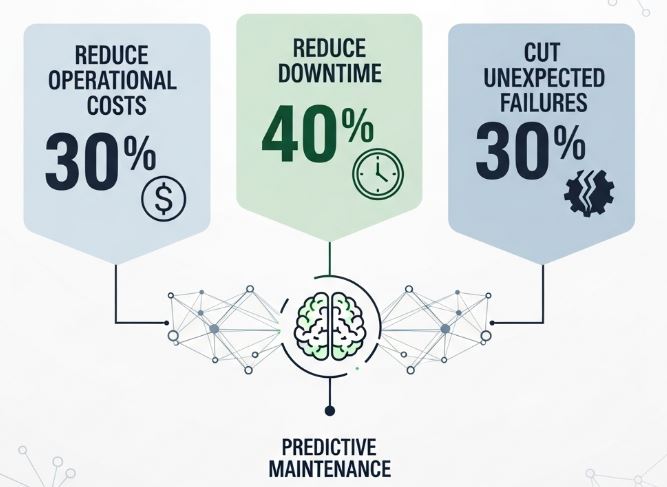
Qualcomm is entering the enterprise server space, pursuing ARM‑based CPUs tailored for AI inference. While revenues are expected only by fiscal 2028, this move signals a shifting architecture landscape. Beyond hardware, AI‑enhanced server management is transforming operations. McKinsey estimates this could reduce operational costs by 30% and downtime by 40% by 2025. Wifitalents data supports this: AI‑driven predictive maintenance has already cut unexpected failures by 30%.
Read more: Cloud Repatriation: Everything You Need To Know
4. Storage Revolution: Massive Gen‑5 Solid State Drives
Micron’s new PCIe Gen‑5 “6600 ION” solid state drive pushes storage boundaries, offering a 122 TB model now and scaling to 245 TB by early 2026. Its staggering density—up to 4.42 PB per 2U unit—represents a 67% improvement over prior generations, with dramatic energy savings. At exabyte scale, it consumes 1 watt per 4.9 TB—enough savings to power 124 U.S. homes daily. This leap will redefine storage-heavy workloads in hyperscale and enterprise data centers.
5. Cooling & Sustainability Innovations
Data center energy and water use are serious concerns. The global water footprint of data centers stands at 560 billion liters annually, and a single 100 MW facility may use 2 million liters per day—equivalent to 6,500 households. In response, advanced cooling solutions are gaining ground. Liquid cooling—including two‑phase immersion (in use by Microsoft)—offers superior thermal control while cutting energy consumption.
Energy efficiency is improving: average PUE (Power Usage Effectiveness) has dropped from 2.0 to 1.5, while rack density is increasing from 10U to 42U. Complementing hardware, green data center frameworks emphasize modular design, reuse of waste heat, ultrasonics, and renewable energy—marking sustainability as a core design parameter of modern facilities.
6. Hyper‑Converged, Composable & Software‑Defined Infrastructure
Servers are becoming more fluid. Hyper-converged infrastructure (HCI), which merges compute, storage, and networking into single systems, is seeing widespread adoption for its simplified, scalable stack. Simultaneously, composable infrastructure allows dynamic reconfiguration of compute, storage, and network on demand. IDC projects the composable market will grow from $4.82 billion in 2022 to $23.36 billion by 2030. Software‑defined servers and data centers—managed through software abstraction—are essential for remote, edge, or hybrid deployments.
Read more: 7 Cybersecurity Trends for 2025 According to IBM
7. Optimization, Security & Hybrid Architecture
Cost, performance and security pressures are driving smarter cloud and server strategies. In 2025, 72% of IT leaders prioritized cloud optimization, recognizing generic cloud setups no longer suffice—especially for HPC or AI workloads. Security grows in prominence. Ransomware attacks surged 150% in 2023, while hardware features like TPM or secure boot are now in 85% of modern servers. Hybrid and multi‑cloud setups—combining on‑prem, private, and public cloud parts—are becoming the default for balancing agility, control, and cost.
Conclusion
By 2026, server infrastructure will be defined by adaptability: choosing the right mix of cloud, dedicated, and edge; integrating AI-optimized hardware and management; embracing ultra-dense storage; and centering on efficiency, modularity, and security. Neglecting these server trends means missing the future of computing—so whether you’re architecting data centers, deploying AI applications, or managing enterprise infrastructure, there’s no ignoring them.
Which of these server trends will make an impact in 2026? Share it with us in the comments section below.

Featured Post
Dedicated Server For Government: Everything You Need to Know
In an era where digital transformation defines national competitiveness, governments around the world are investing heavily in resilient, secure, and scalable infrastructure. Among all infrastructure choices, […]

Sarmad Hasan
March 11, 2026
Dedicated Server with SSD: High-Performance Hosting for Mission-Critical Workloads
A Dedicated Server with SSD (Solid State Drive) is a premium hosting solution in which an entire physical server is allocated to a single user and […]
Sarmad Hasan
March 6, 2026
Dedicated Server with Backup: Everything You Need To Know
A Dedicated Server with backup is a high-performance hosting solution that combines exclusive physical server resources with robust data protection mechanisms. Unlike shared hosting or virtual […]
Sarmad Hasan
March 2, 2026