


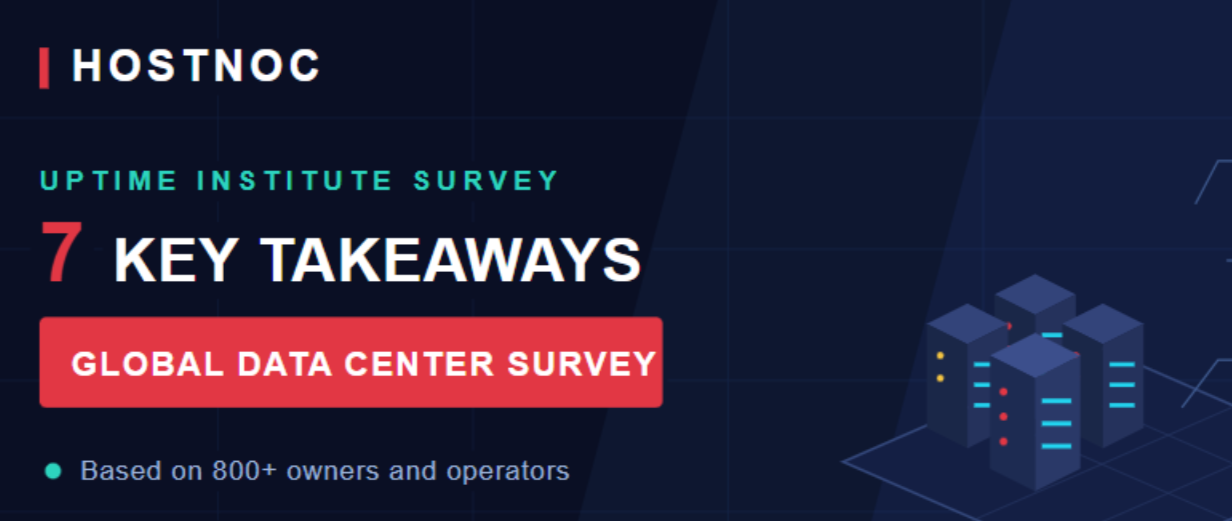
The rapid growth of artificial intelligence, cloud computing and digital services is reshaping the global data center landscape. Enterprises are investing heavily in infrastructure capable of supporting high-density computing while also facing rising costs, power constraints and workforce shortages. The Uptime Institute’s 16 Annual Global Data Center Survey provides valuable insights into how operators are adapting to these changes.
The global data center survey, based on responses from more than 800 data center owners and operators worldwide, highlights significant shifts in infrastructure strategy, operational priorities and emerging challenges. In this article, you will learn about seven key takeaways from Uptime institute’s global data center survey.
7 Key Takeaways from Uptime Institute’s Global Data Center Survey
Here are seven key takeaways from Uptime Institute’s global data center survey.
1. Third-Party Data Centers Now Host 46% of Enterprise Workloads
One of the biggest milestones revealed by the survey is that 46% of enterprise IT workloads are now hosted in third-party data centers, while only 44% remain in company-owned facilities. This marks the first time outsourced infrastructure has overtaken on-premises deployments.
This shift reflects changing business priorities. Rather than investing millions in expanding their own facilities, organizations increasingly rely on colocation providers and managed data centers that offer greater scalability, flexibility, and faster deployment. AI workloads, in particular, require specialized power and cooling systems that many enterprise facilities were never designed to support. As demand for compute resources continues to grow, outsourcing infrastructure is becoming a strategic necessity rather than simply a cost-saving option.
2. Average Rack Power Density Has Exceeded 11 kW
The global data center survey reports that average rack power density has surpassed 11 kilowatts (kW) for the first time, highlighting the growing impact of AI and GPU-based computing.
Traditional enterprise servers consumed relatively modest amounts of power, but modern AI accelerators require significantly more electricity and generate much more heat. As organizations deploy GPU clusters for machine learning and generative AI, data centers must upgrade power distribution, cooling systems, and rack designs. Higher rack densities improve computing capacity but also increase engineering complexity, making infrastructure modernization a top priority for operators.
3. 24% of Operators Now Use Racks Rated at 30 kW or More
Another notable finding is that 24% of surveyed operators now deploy at least some racks with power densities of 30 kW or higher, compared with 19% the previous year. Some AI installations even exceed 100 kW per rack.
This rapid increase demonstrates how quickly AI is transforming physical infrastructure requirements. High-density racks require advanced liquid cooling, enhanced electrical distribution, and more sophisticated facility designs. Organizations planning future data centers must account for these requirements early, as retrofitting older facilities can be expensive and technically challenging. AI is no longer influencing only software strategy—it is fundamentally changing how data centers are built.
4. 71% of Major Outages Cost More Than $100,000
Reliability remains critical, even though data center outage frequency has declined. According to the global data center survey, 71% of operators reported that their most significant outage during the past year cost at least $100,000, a substantial increase from previous years.
These figures demonstrate that while outages may occur less frequently, their financial impact is becoming much greater. Modern businesses depend on uninterrupted digital services, meaning downtime can disrupt operations, damage customer trust, and result in lost revenue. Consequently, organizations continue investing in redundancy, predictive maintenance, resilient network architectures, and disaster recovery capabilities to reduce operational risk.
5. 53% of Operators Struggle to Recruit Qualified Staff
The global data center survey reveals that 53% of data center operators have difficulty finding qualified employees, up from 46% a year earlier. As infrastructure grows more sophisticated, the demand for skilled professionals in electrical engineering, cooling technologies, automation, cybersecurity, and AI infrastructure continues to rise. Unfortunately, the talent pipeline has not kept pace with industry growth. Many organizations are responding by increasing automation, investing in workforce training, and outsourcing certain operational functions. However, the shortage of experienced personnel remains one of the industry’s most pressing long-term challenges.
6. High Costs Remain the Industry’s Biggest Concern
The global data center survey identifies rising costs as the leading concern for digital infrastructure management teams in 2026. Beyond operational expenses, organizations are increasingly worried about power availability, capacity forecasting, and supply chain disruptions. Building modern AI-ready facilities requires significant investments in electrical infrastructure, cooling technologies, networking equipment, and specialized hardware. At the same time, energy prices remain volatile, and utilities in several regions face growing pressure from increasing electricity demand. These financial pressures are forcing operators to carefully balance expansion plans with long-term sustainability and return on investment.
7. Power Efficiency Improvements Continue to Be Gradual
Despite advances in cooling technology and facility design, the survey notes that improvements in Power Usage Effectiveness (PUE) remain relatively modest across the industry. Many newly constructed facilities achieve impressive efficiency levels, but older legacy data centers continue to limit overall progress. Operators must modernize existing infrastructure while simultaneously supporting increasingly power-hungry AI workloads. This balancing act illustrates that sustainability is no longer simply an environmental objective—it has become an operational and financial imperative. Better energy efficiency helps reduce operating costs while supporting corporate environmental goals.
Conclusion
The Uptime Institute’s Global Data Center Survey paints a clear picture of an industry undergoing rapid transformation. AI adoption is accelerating demand for high-density infrastructure, driving enterprises toward third-party facilities while increasing power requirements and operational complexity. At the same time, operators face rising costs, workforce shortages, and ongoing pressure to improve reliability and sustainability.
For enterprise IT leaders, these findings underscore the importance of long-term infrastructure planning. Investments in resilient architectures, energy-efficient technologies, skilled talent, and scalable data center strategies will determine how effectively organizations can support the next generation of AI-driven applications. As digital transformation continues, the data center will remain at the heart of business innovation, making these survey insights valuable guidance for future technology decisions.

Featured Post
Single vs Multi-Core Performance: Epic Showdown
Key Takeaways Single-core performance determines how fast a processor handles one task...

Computex 2026: Top Product Announcements
At Computex 2026 in Taipei, the technology industry highlighted a major shift...
Follow us on:


Get the Latest News & Deals
Sign up to receive the latest news, updates and special offers from HostNOC.
I'd like to receive:


