


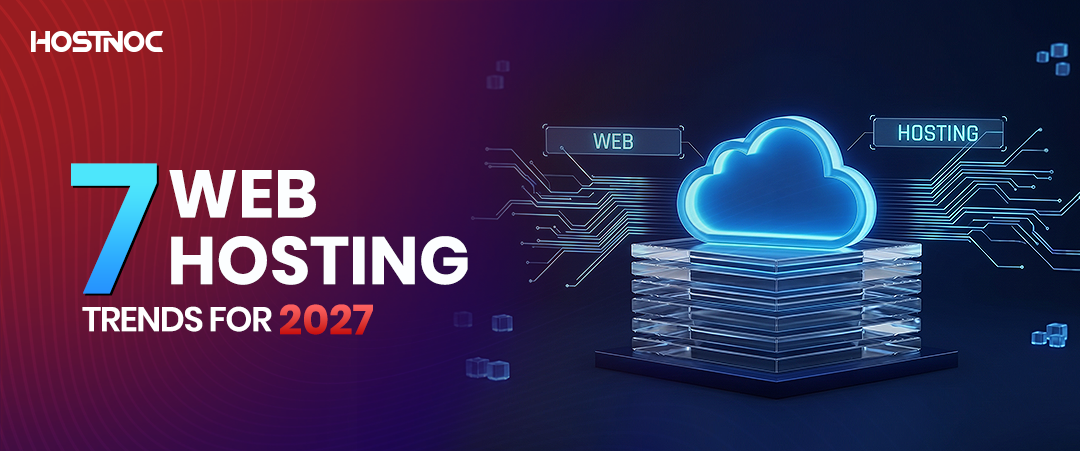
The web hosting industry is moving beyond the traditional model of simply providing server space, bandwidth and uptime. AI-driven workloads, edge computing, hybrid infrastructure, cybersecurity, sustainability and increasingly sophisticated applications are changing what businesses expect from their hosting providers. HostNOC’s 2026 outlook already identified AI-powered hosting, edge computing, green infrastructure, hybrid and multi-cloud environments, serverless architectures and stronger security as major forces reshaping hosting.
For businesses, the problem is straightforward: websites and applications that rely on outdated hosting infrastructure can become slower, less secure, harder to scale and more expensive to operate. As traffic patterns, AI workloads and security threats continue to evolve, choosing a hosting architecture based only on price is increasingly risky. The solution is to understand where hosting infrastructure is heading before making the next technology investment. In this article, you will learn about seven web hosting trends for 2027.
7 Web Hosting Trends for 2027
Here are seven web hosting trends for 2027.
1. AI-Native Hosting Will Move From Optimization to Autonomous Infrastructure
AI-powered hosting will become more deeply embedded into the infrastructure layer rather than remaining a collection of monitoring and support features. Hosting platforms will increasingly use machine learning for predictive maintenance, intelligent resource allocation, automated scaling, anomaly detection, server optimization and cybersecurity response. A cPanel survey found that 53% of hosting providers expect AI-driven automation to have the biggest impact on the industry in the future.
In 2027, the next step will be more autonomous infrastructure: systems that can detect unusual traffic, predict resource exhaustion, move workloads, adjust CPU or memory allocation and initiate remediation with minimal human intervention. For businesses, this means looking beyond a hosting provider that merely offers “AI features” and evaluating whether its infrastructure can provide AI-assisted monitoring, automated scaling, intelligent security and workload-aware resource management.
2. Edge Hosting Will Become a Standard Performance Layer
In 2027, edge computing will increasingly become part of mainstream web hosting rather than an architecture reserved for specialized applications. Instead of sending every request to a centralized origin server, content delivery networks, edge servers, edge functions and distributed compute locations will process more application logic closer to end users. This is particularly important for global eCommerce, streaming platforms, online gaming, IoT applications, financial services and interactive web applications where milliseconds can affect user experience.
By 2027, hosting providers will increasingly differentiate themselves through geographic coverage, edge compute capabilities, intelligent traffic routing and origin-to-edge integration. Businesses should therefore assess not just where their primary server is located but how effectively their hosting architecture can deliver dynamic content and application logic to users across different regions.
3. Hybrid and Multi-Cloud Hosting Will Become the Default Enterprise Strategy
The “one cloud for everything” approach will continue giving way to hybrid and multi-cloud hosting architectures that combine public cloud, private infrastructure, dedicated servers, VPS environments, and colocation according to workload requirements. Experts has already identified hybrid and multi-cloud approaches as an important hosting direction because organizations increasingly need flexibility, redundancy, cost control and greater infrastructure choice.
In 2027, businesses will increasingly place predictable, performance-sensitive or compliance-heavy workloads on dedicated or private infrastructure while using public cloud resources for elastic workloads and rapid deployment. This approach can also reduce vendor lock-in and provide greater control over infrastructure costs. The key trend will not simply be “multi-cloud” but workload-specific infrastructure selection, choosing the environment that offers the best combination of performance, security, compliance, scalability and total cost of ownership.
4. Sustainable Hosting Will Shift From Marketing Claim to Measurable Infrastructure
Green hosting will become much more specific in 2027. Instead of relying on broad claims such as “eco-friendly hosting,” customers will increasingly want evidence of energy efficiency, renewable-energy sourcing, Power Usage Effectiveness (PUE), efficient cooling, hardware utilization and carbon impact. Experts have already highlighted green hosting and data-center efficiency as important industry developments while newer industry analysis points toward greater scrutiny of how hosting providers substantiate sustainability claims.
The rise of AI workloads makes this particularly important because GPU-intensive infrastructure can significantly increase power and cooling requirements. Consequently, sustainable hosting in 2027 will increasingly involve energy-efficient servers, liquid cooling, renewable-powered data centers, workload optimization, hardware lifecycle management and transparent environmental reporting. For organizations with ESG commitments or sustainability reporting requirements, infrastructure efficiency will become an increasingly relevant factor when selecting a hosting provider.
5. Security Will Evolve Toward AI-Assisted Zero-Trust Hosting
Cybersecurity will become an integrated property of hosting infrastructure rather than an optional add-on. Traditional protections such as firewalls, malware scanning, SSL/TLS certificates, backups, and intrusion detection will increasingly be combined with AI-powered threat detection, behavioral analytics, automated incident response, identity controls, and Zero Trust security models. Experts specifically identified security and Zero Trust as major infrastructure priorities, while its earlier research described how AI can analyze user behavior and identify potentially malicious activity in real time.
In 2027, hosting environments will need to assume that threats can originate from compromised accounts, APIs, applications, containers, and legitimate-looking traffic—not simply from obvious external attacks. Businesses should therefore prioritize hosting providers offering DDoS protection, network segmentation, automated threat detection, secure boot or hardware security capabilities, regular backups, vulnerability monitoring, MFA, and Zero Trust access controls.
6. GPU Hosting and AI-Ready Infrastructure Will Become a Distinct Hosting Category
The growth of generative AI and AI inference will create a much clearer divide between conventional web hosting and AI-ready infrastructure. Websites may still run effectively on CPU-based virtual servers, but AI applications, recommendation engines, computer-vision systems, large language models, and real-time inference increasingly require specialized accelerators such as GPUs, high-bandwidth networking, fast NVMe storage, and large memory configurations.
In 2027, hosting providers will increasingly offer dedicated GPU servers, GPU-enabled cloud instances, private AI infrastructure, and optimized inference environments alongside conventional VPS and dedicated hosting. This will make GPU availability, VRAM capacity, interconnect performance, storage throughput, power efficiency, and data locality important hosting-selection criteria for AI-focused businesses.
7. Serverless, Containers and Developer-Centric Hosting Will Reshape Application Deployment
Hosting will become increasingly application-centric as developers adopt containers, Kubernetes, serverless functions, WebAssembly, managed databases, CI/CD pipelines, and Infrastructure as Code. Rather than purchasing a server and manually configuring every component, development teams will increasingly expect hosting platforms to provide automated deployment, container orchestration, observability, scaling, security, and API-driven infrastructure management. Expert analysis already identified serverless architectures and containerization as important developments alongside edge computing.
In 2027, the competitive advantage will increasingly belong to hosting providers that make infrastructure easier to consume programmatically. For developers, that means faster deployments and more granular scaling; for businesses, it means shorter development cycles and infrastructure that can adapt to application demand without constant manual intervention. Hosting will increasingly resemble a developer platform rather than a traditional server-management service.
Conclusion
The web hosting industry in 2027 will be defined by a shift from basic server provisioning toward intelligent, distributed, secure, sustainable, and application-aware infrastructure. AI will automate infrastructure management, edge computing will reduce latency, hybrid and multi-cloud architectures will improve flexibility, green data centers will face greater scrutiny, Zero Trust will strengthen security, GPU infrastructure will support AI workloads, and serverless and containerized platforms will simplify application deployment.
For businesses planning their next hosting investment, the key question in 2027 will no longer be “Which hosting plan is cheapest?” but “Which infrastructure can deliver the performance, security, scalability, intelligence, and efficiency my business will need next?”
Which of these web hosting trends will make an impact in 2027? Share it with us in the comments section below.

Featured Post
10 Common n8n Hosting Mistakes and How to Avoid Them
Self-hosting n8n is one of the best ways to build secure, customizable...

Web Hosting for Large Businesses: A Comprehensive Enterprise Guide
Web hosting for large businesses is fundamentally different from hosting for small...

When to Upgrade Your Hosting Plan? Complete Guide for Growing Websites
Choosing the right web hosting plan is one of the most critical...
Follow us on:


Get the Latest News & Deals
Sign up to receive the latest news, updates and special offers from HostNOC.
I'd like to receive: