


FileZilla FTP Connection Timeout Error: 10 Proven Fixes (2026)

The FileZilla FTP connection timeout error is a common issue during file transfers between local machines and remote servers, arising from inactivity or delays causing the connection to be terminated. Various factors, such as server configuration, network problems, or firewall settings, can contribute to this problem.
To troubleshoot, users should review and adjust timeout settings in FileZilla, ensure uninterrupted network connectivity, and check for firewall interferences. Additionally, examining and adjusting server-side configurations, such as connection limits and timeout values, can help prevent this error. By systematically addressing these issues, users can enhance FTP connection stability and reduce the occurrence of timeout errors in FileZilla.
This article will tell you everything you need to know about Filezilla FTP connection timeout error.
A FileZilla FTP connection timeout error happens when FileZilla waits too long for a response from the server and gives up. You might see messages like “Connection timed out after 20 seconds of inactivity”, “Could not connect to server” or “ETIMEDOUT”. The result is always the same: uploads stop, directory listings fail and your work comes to a halt. FileZilla is one of the most popular FTP clients in the world, so this is an error almost every web developer meets sooner or later.
🔑 Key Takeaways
- A FileZilla FTP connection timeout means the client did not get a response from the server within the timeout limit.
- The most common causes are wrong transfer mode (Active vs Passive), firewalls blocking FTP ports, unstable internet and server limits.
- Quick fixes include increasing the timeout value, switching to Passive mode, enabling keep-alive and using SFTP instead of plain FTP.
- Server-side settings such as passive port ranges, idle timeouts and connection limits must also be correct.
The good news is that a FileZilla FTP connection timeout is almost always fixable in a few minutes. Most cases come down to a handful of settings on your computer, your network or the server.
This guide explains what the FileZilla FTP connection timeout error means, why it happens and 10 proven fixes you can apply right now, from simple client tweaks to server-side configuration.
☰ Table of Contents (click to expand)
- What Is the FileZilla FTP Connection Timeout Error?
- What Causes a FileZilla FTP Connection Timeout?
- How to Read the FileZilla Message Log
- How to Fix the FileZilla FTP Connection Timeout Error
- Fixing FTP Timeouts on Mac and Linux
- FTP vs FTPS vs SFTP: Which Should You Use?
- How to Prevent FileZilla FTP Connection Timeouts
- When the Problem Is Your Hosting
- Conclusion
- FAQs
What Is the FileZilla FTP Connection Timeout Error?
FTP (File Transfer Protocol) uses two separate connections. The control connection, usually on port 21, sends commands such as login, list and upload. The data connection carries the actual files and folder listings. If either connection stops responding for longer than FileZilla’s timeout limit, the client closes it and reports a timeout.
The error can appear in different ways:
- “Error: Connection timed out after 20 seconds of inactivity”
- “Error: Could not connect to server”
- “Error: Connection attempt failed with ETIMEDOUT – Connection attempt timed out”
- “Error: Failed to retrieve directory listing”
- Transfers that freeze at a certain percentage and never finish
If you can log in but the directory listing fails, the problem is usually the data connection. If you cannot connect at all, it is often the control connection, the host address, the port or a firewall.
What Causes a FileZilla FTP Connection Timeout?
Wrong Transfer Mode (Active vs Passive)
In Active mode, the server connects back to your computer to open the data connection. Home routers and firewalls usually block this. In Passive mode, your computer opens both connections, which works better behind NAT and firewalls. A mismatch between your network and the selected mode is the single most common cause of a FileZilla FTP connection timeout.
Firewall, Antivirus or Router Blocking FTP
Local firewalls, antivirus suites with network protection and router security features may block FTP ports or inspect FTP traffic in ways that break the connection.
Unstable or Slow Internet Connection
Packet loss, weak Wi-Fi and overloaded networks can delay responses long enough to trigger the timeout, especially when transferring large files.
Server-Side Limits and Misconfiguration
The FTP server may have a closed passive port range, a low idle timeout, a limit on simultaneous connections per IP or high load. Any of these can make the server stop responding.
Incorrect Connection Details
A wrong host name, port or protocol (for example, connecting to an SFTP server with plain FTP) will lead to failed connection attempts that end in a timeout.
Too Many Simultaneous Connections
FileZilla opens several connections for parallel transfers. Many shared hosting servers allow only a few connections per user, so extra ones hang and time out.
| Symptom | Likely Cause | Quick Fix |
|---|---|---|
| Cannot connect at all | Wrong host or port, firewall, server down | Check details, test port, contact host |
| Login works, listing fails | Data connection blocked | Switch to Passive mode |
| Times out after idle period | Low timeout or no keep-alive | Raise timeout, enable keep-alive |
| Large uploads freeze | Unstable network or server limits | Lower simultaneous transfers, use SFTP |
| Works on one network only | Router or ISP blocks FTP | Use SFTP or another network |
How to Read the FileZilla Message Log
Before changing settings, look at the message log at the top of the FileZilla window. It shows every command and response, and it tells you exactly where the connection stops. Here is what to look for:
- The log stops at “Connecting to…”: FileZilla cannot reach the server at all. Check the host name, port, firewall and whether the server is online.
- Login succeeds, then “Entering Passive Mode” is followed by a timeout: The data connection is blocked. Check Passive mode, the server’s passive port range and the firewall.
- “Connection timed out after 20 seconds of inactivity” appears after you stop working: The session went idle. Increase the timeout and enable keep-alive.
- The log shows “Server sent passive reply with unroutable address”: The server is behind NAT and sends a private IP. FileZilla can use the server’s external address instead, but the best fix is to set the public IP on the server.
For deeper troubleshooting, enable detailed logging in Edit > Settings > Debug and set the debug level to “Verbose”. Share this log with your hosting provider when you ask for help with a FileZilla FTP connection timeout, as it shows them exactly what happened.
How to Fix the FileZilla FTP Connection Timeout Error
Work through these fixes in order. Most users solve the FileZilla FTP connection timeout within the first four steps.
1. Check Your Internet Connection
A weak network is a common trigger for a FileZilla FTP connection timeout, so make sure your connection is stable. Open a few websites, run a speed test and, if possible, switch from Wi-Fi to a wired connection. If the error only happens on one network, try a mobile hotspot to confirm whether the network is the issue.
2. Verify Your Connection Details
Double-check the host, username, password, port and protocol. Use port 21 for FTP and FTPS (explicit), and port 22 for SFTP. Many hosting providers use SFTP by default, so connecting with plain FTP to an SFTP-only server will fail. You can learn more in our guide to the SFTP port.
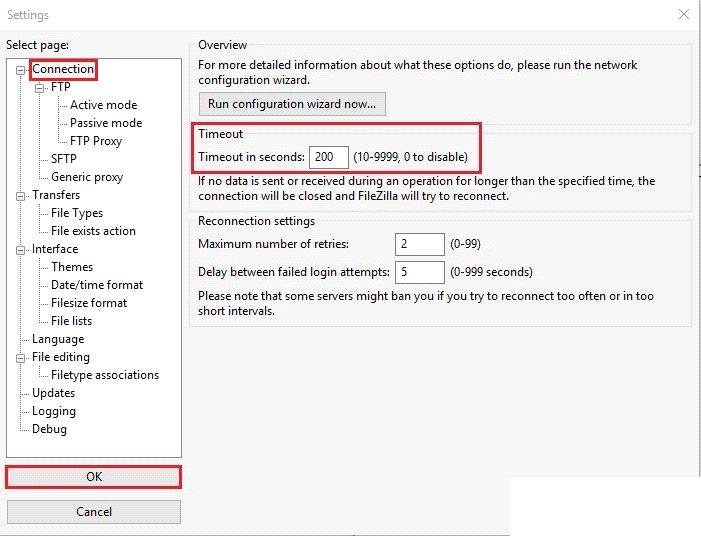
3. Increase the Timeout Value in FileZilla
FileZilla’s default timeout is 20 seconds. On slow servers or large transfers, raise it:
- Open FileZilla and go to Edit > Settings (on macOS: FileZilla > Settings).
- Select Connection in the left menu.
- Change Timeout in seconds from 20 to 60 or 120.
- Click OK and reconnect.
Setting the value to 0 disables the timeout entirely, but this is not recommended, because a dead connection will then hang forever.
4. Switch to Passive Transfer Mode
Go to Edit > Settings > Connection > FTP and set the transfer mode to Passive (recommended). Also tick Allow fallback to other transfer mode on failure. For a single site, open File > Site Manager > Transfer Settings and choose Passive there. This one change fixes a large share of FileZilla FTP connection timeout problems.
5. Enable FTP Keep-Alive
If the FileZilla FTP connection timeout appears after a period of inactivity, turn on keep-alive commands. In Edit > Settings > Connection > FTP, tick Send FTP keep-alive commands. FileZilla will then send small commands to keep the session open while you are not transferring files.
HostNOC Tip: If you edit files directly on the server and leave FileZilla idle for long periods, keep-alive plus a 60-second timeout usually stops the “timed out after 20 seconds of inactivity” message for good.
6. Limit Simultaneous Connections
Go to Edit > Settings > Transfers and reduce Maximum simultaneous transfers to 1 or 2. For a specific site, open Site Manager > Transfer Settings, tick Limit number of simultaneous connections and set it to 2. This stops the server from rejecting extra connections.
7. Check Firewall and Antivirus Settings
Temporarily disable your firewall or antivirus and try again. If the connection works, add an exception for filezilla.exe instead of leaving protection off. On routers, disable features such as “FTP ALG” or “SPI for FTP” if they interfere with passive connections. Corporate networks may block FTP completely, so ask your IT team if needed.
8. Update FileZilla
Outdated software can also cause a FileZilla FTP connection timeout. Older versions may contain bugs or outdated security protocols that fail with modern servers. Go to Help > Check for updates and install the latest version. Always download FileZilla from the official website only.
9. Use SFTP Instead of FTP
SFTP runs over a single encrypted SSH connection on port 22, so there is no separate data connection to get blocked. Switching to SFTP solves many FileZilla FTP connection timeout problems and makes your transfers secure at the same time. In Site Manager, set the Protocol to SFTP – SSH File Transfer Protocol and use port 22.
10. Check Server Status and Configuration
If you manage the FTP server, review these settings:
- Passive port range: Define it in your FTP server and open the same range in the server firewall.
- External IP: If the server is behind NAT, set its public IP address for passive mode.
- Idle and data timeouts: Increase values that are too low.
- Connection limits: Allow enough connections per IP for your users.
- Server load: Check CPU, RAM and disk activity. An overloaded server responds slowly.
For example, on a Linux server running vsftpd, the passive settings in /etc/vsftpd.conf look like this:
pasv_enable=YES
pasv_min_port=40000
pasv_max_port=40100
pasv_address=YOUR_PUBLIC_IP
idle_session_timeout=600
data_connection_timeout=300
Then open the passive range in the firewall and restart the service:
sudo ufw allow 20:21/tcp
sudo ufw allow 40000:40100/tcp
sudo systemctl restart vsftpd
If you are on shared hosting, contact your hosting provider and ask them to check the FTP service and confirm your connection details.

Need a Faster, More Reliable Server?
Get HostNOC VPS and dedicated servers with full root access, SFTP support, NVMe storage and 24/7 expert help.
Fixing FTP Timeouts on Mac and Linux
The FileZilla FTP connection timeout fixes above work the same way on Windows, macOS and Linux, but a few platform details are worth knowing. On macOS, the settings menu is under FileZilla > Settings rather than Edit, and the built-in macOS firewall may ask you to allow incoming connections for FileZilla the first time you connect. Click “Allow”, or add FileZilla in System Settings > Network > Firewall > Options.
On Linux desktops, check whether ufw or firewalld is active and blocking outgoing connections on non-standard ports. Running sudo ufw status shows the current rules. You can also test whether the FTP port is reachable from the terminal with nc -vz ftp.example.com 21 or, for SFTP, nc -vz ftp.example.com 22. If the test fails, the issue is the network or server, not FileZilla.
FTP vs FTPS vs SFTP: Which Should You Use?
| Protocol | Default Port | Encryption | Timeout Risk |
|---|---|---|---|
| FTP | 21 plus data ports | None | Higher, needs extra data ports |
| FTPS (explicit) | 21 plus data ports | TLS | Higher, firewalls cannot inspect traffic |
| SFTP | 22 | SSH | Lower, uses a single connection |
For most users, SFTP is the best choice. It is secure, firewall-friendly and far less likely to trigger a FileZilla FTP connection timeout. Plain FTP sends passwords in clear text and should be avoided on public networks.
How to Prevent FileZilla FTP Connection Timeouts
- Use SFTP whenever your host supports it.
- Keep Passive mode as the default transfer mode.
- Set the timeout to 60 seconds and enable keep-alive.
- Limit simultaneous connections on shared hosting.
- Use a stable, wired connection for large uploads.
- Keep FileZilla and your server software updated.
- Compress large folders into a single archive before uploading.
- Choose hosting with fast storage and enough resources to handle file transfers.
Most FTP timeouts are not mysterious. They are a firewall, a transfer mode or a timeout value waiting to be fixed.
When the Problem Is Your Hosting
If you have tried every fix and the FileZilla FTP connection timeout keeps coming back, the server may be the real issue. Shared hosting plans often limit connections, throttle bandwidth and run on overloaded machines. Moving to a Linux VPS or dedicated server gives you full control over FTP and SFTP settings, firewalls and resources. Similar server-side problems can also cause errors like the 502 Bad Gateway error, so a well-configured server pays off across the board.
Conclusion
A FileZilla FTP connection timeout is frustrating, but it is rarely hard to fix. Start by checking your internet connection and login details, then raise the timeout, switch to Passive mode, enable keep-alive and limit simultaneous connections. If the problem continues, review your firewall, update FileZilla, move to SFTP and check the server’s passive port range and timeout settings.
With the right settings on both the client and the server, your file transfers will run smoothly and securely. And if your current host keeps getting in the way, HostNOC’s servers give you the speed and control you need.
Transfer Files Without Timeouts
Move to HostNOC servers with fast networking, secure SFTP access and expert support available 24/7.
FAQs
FileZilla FTP Connection Timeout: Frequently Asked Questions
Quick answers to the questions people ask most.
What causes a FileZilla FTP connection timeout?
Common causes are the wrong transfer mode, firewalls or antivirus blocking FTP ports, an unstable internet connection, a low timeout value, too many simultaneous connections and server-side limits or misconfiguration.
How do I increase the timeout in FileZilla?
Go to Edit, then Settings, then Connection, and change Timeout in seconds from the default 20 to 60 or 120. Click OK and reconnect to the server.
Should I use Active or Passive mode in FileZilla?
Passive mode is recommended for most users because it works better behind home routers, NAT and firewalls. You can set it in Edit, Settings, Connection, FTP.
Why does FileZilla say “Failed to retrieve directory listing”?
This usually means the control connection works but the data connection is blocked. Switching to Passive mode, opening the passive port range on the server or using SFTP normally fixes it.
Does SFTP fix FTP timeout errors?
Often, yes. SFTP uses a single encrypted connection on port 22, so there is no separate data connection to be blocked by firewalls. It is also much more secure than plain FTP.
Can my hosting provider cause FTP timeouts?
Yes. Shared hosting servers may limit connections, close passive ports or be overloaded. If client-side fixes do not help, contact your host or move to a VPS or dedicated server.

Muhammad Osama
Featured Post

n8n Docker Installation Guide: Complete Step-by-Step Setup for Beginners and Production
Step-by-step n8n Docker installation guide covering Docker Compose, PostgreSQL, HTTPS, environment variables,...

15 n8n Workflow Examples to Automate Your Business
Real n8n workflow examples for marketing, sales, support, AI and DevOps, with...



n8n Workflows for Businesses: A Comprehensive Guide
A complete guide to n8n workflows for businesses: how they work, core...
Follow us on:


Get the Latest News & Deals
Sign up to receive the latest news, updates and special offers from HostNOC.
I'd like to receive: