


Key Takeaways
- Agentic AI will move from answering prompts to executing multi-step business processes with tools, permissions and measurable outcomes.
- Physical AI and robotics will bring foundation-model intelligence into warehouses, factories, logistics and field operations.
- AI-native software development will change how applications are designed, tested, deployed and maintained.
- AI infrastructure and edge computing will become strategic assets as inference demand pushes organizations closer to specialized compute.
- Post-quantum cryptography and AI security will become board-level concerns as autonomous systems expand the attack surface.
- Domain-specific AI and sovereign computing will matter more than simply choosing the largest general-purpose model.
- Digital provenance and trusted data will become essential for distinguishing authentic information from synthetic or manipulated content.
The technology landscape entering 2027 will be defined less by individual gadgets and more by the convergence of AI agents, specialized computing, robotics, cybersecurity and trusted digital infrastructure. The important shift is from AI as a software feature to AI as an operational layer: systems will increasingly reason, use tools, interact with other systems and influence decisions in the physical world. Gartner and IEEE are already identifying agentic AI, physical AI, AI infrastructure and security as major forces shaping enterprise technology.
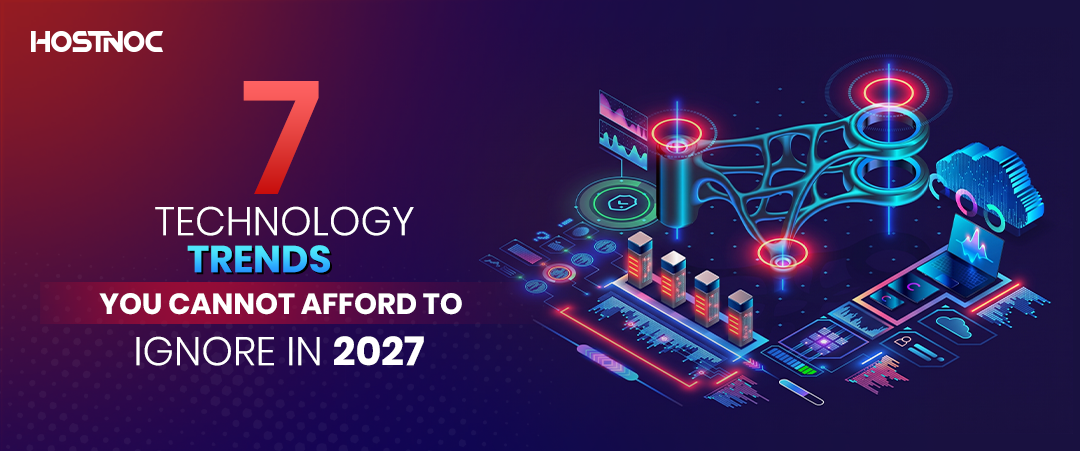
7 Technology Trends You Cannot Afford to Ignore in 2027
Here are seven technology trends you cannot afford to ignore in 2027.
1. Agentic AI Will Become the New Enterprise Interface
In 2027, the competitive advantage will shift from owning an AI chatbot to deploying AI agents that can actually complete work. Instead of merely generating an email or summarizing a report, an agent can retrieve information, update a CRM, create a ticket, analyze documents and escalate exceptions.
The architecture will increasingly combine large language models, tool calling, retrieval-augmented generation (RAG), APIs, identity controls and workflow orchestration. Multiagent systems will allow specialized agents to collaborate—for example, a research agent can brief a planning agent while a compliance agent checks the resulting recommendation. Gartner already identifies multiagent systems as a major strategic technology trend.
This will create a new enterprise security problem: non-human identities. Organizations will need to know which agent has access to which database, what actions it can authorize and how its activity can be audited. In 2027, “Who has access?” will increasingly mean both humans and autonomous software.
2. Physical AI Will Move Intelligence Into the Real World
AI will increasingly stop living exclusively inside data centers and start operating machines, robots, vehicles and industrial equipment. Physical AI combines perception, reasoning and action, enabling machines to interpret changing environments rather than following only rigid pre-programmed instructions.
Companies such as NVIDIA, ABB, Rockwell Automation and AMD are positioned around different layers of this emerging ecosystem, spanning accelerated computing, industrial automation, robotics and edge infrastructure. Current industry analysis is already describing humanoid robotics as part of a broader “physical AI” shift.
The important development is not simply humanoid robots. Expect AI-powered warehouse robots, autonomous inspection systems, agricultural machines, delivery platforms and industrial cobots to become increasingly capable. Gartner likewise identifies physical AI as a strategic technology because it connects AI models with robots, drones and intelligent equipment.
3. AI-Native Software Development Will Redesign the Developer Stack
By 2027, software teams will increasingly design applications around AI from day one rather than adding AI after the product is built. AI coding assistants will evolve into development agents capable of understanding repositories, generating tests, modifying multiple files, debugging failures and opening deployment workflows.
The stack will increasingly include AI coding agents, automated testing, model gateways, vector databases, observability platforms and policy controls. Developers will spend less time manually producing boilerplate code and more time specifying architecture, reviewing generated changes and validating system behavior.
This does not mean programmers disappear. It means the unit of productivity changes from writing individual functions to supervising entire software workflows. Gartner already lists AI-native development platforms among its leading strategic trends and separately identifies AI-driven software engineering as a longer-term disruptive force.
4. AI Supercomputing and Edge AI Will Become Strategic Infrastructure
The AI race will increasingly be an infrastructure race involving GPUs, networking, power, data centers and edge inference—not simply a race to build larger models. Training and inference workloads are creating enormous demand for accelerated computing, while latency-sensitive applications increasingly need computation closer to users and machines.
The ecosystem will involve technologies such as NVIDIA CUDA and Blackwell-class accelerators, AMD Instinct, Google Cloud TPU infrastructure, AWS AI infrastructure and high-speed networking. Gartner specifically identifies AI supercomputing platforms as a strategic trend, while Deloitte highlights edge AI and neuromorphic computing as important signals to watch.
For businesses, the practical question will become where should inference happen? A financial model may run in a controlled cloud environment, while a factory robot or autonomous inspection camera may need local inference because milliseconds matter and continuous cloud connectivity is impractical.
5. Cybersecurity Will Shift From Reactive Defense to AI-Native Protection
Organizations will need AI to defend against AI because autonomous attackers can operate faster than traditional security teams can respond. Attackers can already automate phishing, reconnaissance, vulnerability discovery and social engineering; increasingly autonomous defensive systems will therefore become necessary.
The security stack will expand beyond conventional endpoint protection toward AI security platforms, identity-aware controls, behavioral analytics, automated response and continuous attack-surface monitoring. Gartner’s 2026 framework explicitly identifies preemptive cybersecurity and AI security platforms as strategic priorities.
The biggest change will be the expansion of the attack surface. Every AI agent, API connection, model, plugin and machine identity creates another pathway that must be controlled. Security teams will therefore need to govern not only devices and employees but also autonomous software acting on behalf of the organization.
6. Post-Quantum Cryptography Will Move From Research Topic to Migration Project
Organizations that handle sensitive information should treat post-quantum cryptography as a migration problem now, not a technology problem to solve later. Cryptographically relevant quantum computers are not a 2027 certainty, but replacing deeply embedded cryptographic infrastructure can take years.
The key development is the transition toward post-quantum cryptographic algorithms standardized by NIST, particularly mechanisms designed to resist attacks from future quantum computers. The risk is especially important for information that must remain confidential for many years because adversaries can potentially collect encrypted data today and attempt to decrypt it later.
At the same time, businesses should avoid confusing quantum computing with “quantum AI.” Gartner currently expects enterprise AI workloads at scale to remain on classical accelerated computing through 2028, noting that there is not yet a peer-reviewed demonstration of quantum advantage for production AI workloads.
7. Trusted, Sovereign and Domain-Specific AI Will Beat Generic AI in Critical Workflows
The winning enterprise AI system in 2027 will often be the one with the best data, context, governance and jurisdictional controls—not necessarily the biggest model. Banks, hospitals, manufacturers, governments and legal organizations increasingly need models that understand their terminology, workflows, regulations and proprietary information.
That creates demand for domain-specific language models, retrieval systems, semantic layers, confidential computing and sovereign cloud architectures. Gartner identifies domain-specific models, confidential computing and geopatriation among its strategic technology trends, reflecting the growing importance of specialization, privacy and control.
Digital provenance will become equally important. Organizations will need mechanisms to establish where data, software and AI-generated content originated and whether it has been modified. As synthetic media becomes commonplace, trust itself becomes infrastructure—particularly for financial records, government communications, scientific information and corporate decision-making.
Conclusion
The defining technology story of 2027 will not be a single breakthrough but the convergence of autonomous AI, specialized infrastructure, physical machines and new trust mechanisms. Companies that treat these technologies as isolated experiments may accumulate pilots without gaining strategic advantage; companies that connect agents to reliable data, secure infrastructure, physical operations and measurable business processes can build genuinely different operating models. The signal from current research is already clear: AI agents, physical AI, AI-native development, advanced infrastructure and security are moving from futuristic concepts toward practical enterprise priorities.

Featured Post
10 Things That Is Keeping IT Leaders Up at Night
The role of the Chief Information Officer (CIO) has evolved from operational...

Liquid Vs Air Cooling: Which One You Should Choose To Keep Your Data Center Cool?
Liquid Vs Air Cooling: Different Types Before comparing Liquid vs Air cooling,...
How Generative AI Will Impact Data Centers?
Enterprise adoption of generative AI is in its early stages, but is...
Follow us on:


Get the Latest News & Deals
Sign up to receive the latest news, updates and special offers from HostNOC.
I'd like to receive: